
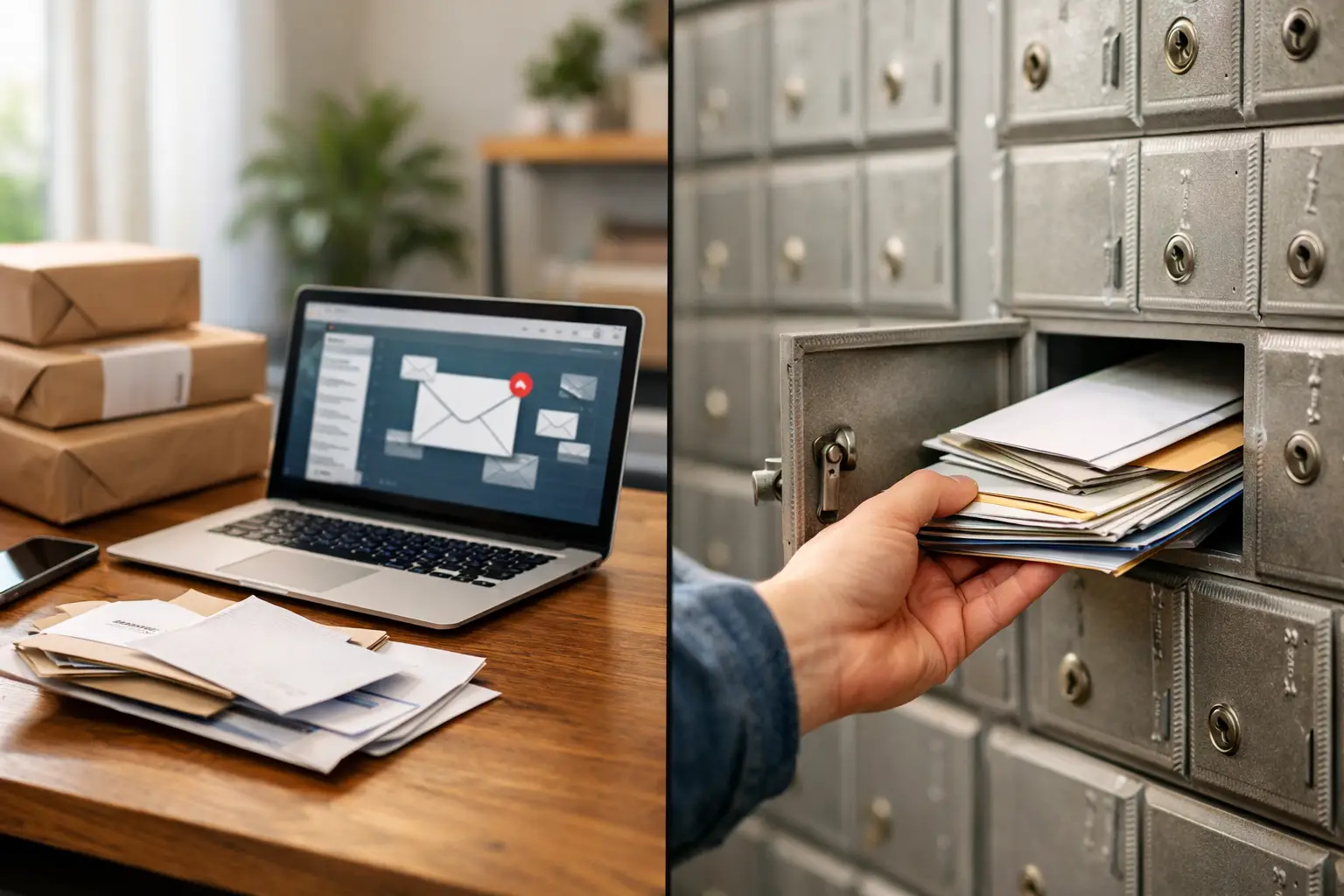
If you split your time between countries, manage a property from abroad, or run a business without a fixed office, post can become a weak point surprisingly quickly. The question of virtual mailbox vs PO box usually comes up when missed deliveries, delayed official letters, or an unreliable building post room start causing real problems.
At first glance, both options seem to solve the same issue. They give you a place to receive post when your home address is not ideal. But in practice, they work very differently. One is essentially a locked container at a postal facility. The other is a managed address service that gives you remote visibility and control.
Virtual mailbox vs PO box: the core difference
A PO box is a box at a post office or postal depot where your letters are delivered for collection. You normally need to visit in person to check what has arrived. It is simple, familiar, and can work well if you live locally and only need basic letter receipt.
A virtual mailbox is a real street address where your post is received by a service provider on your behalf. Instead of travelling to collect envelopes, you can usually view incoming items online, request scans, arrange forwarding, and in many cases receive parcels too. It is designed for people who are not always physically present.
That difference matters more than it may seem. A PO box stores post. A virtual mailbox helps you manage it.
When a PO box still makes sense
A PO box is not outdated. For some people, it remains the most practical option.
If you live full-time in one area, do not travel often, and are happy to collect your post yourself, a PO box can be enough. It may also suit you if your main concern is keeping your residential address private for standard correspondence.
There is also a simplicity to it. No scanning decisions, no forwarding instructions, no digital dashboard. You rent the box, your post arrives, and you collect it. If your needs are minimal, that can be perfectly reasonable.
The limitation is that minimal service is exactly what you are paying for. Once you need flexibility, parcel handling, or remote access, the PO box model starts to feel restrictive.
Where a virtual mailbox has the advantage
For seasonal residents, expats, remote workers, and business owners, the strongest benefit of a virtual mailbox is control without being on site.
If an official letter arrives while you are in another country, you do not have to wait until your next visit to find out what it says. If a client sends documents to your business address, you can be notified quickly and decide whether to scan, store, or forward them. If a courier attempts a parcel delivery, there is a much better chance that someone is available to receive it.
This is especially useful in places where building-level post handling is inconsistent. Shared entrances, holiday developments, and unattended properties are all common weak spots. A managed postal address reduces the risk of important items being left unattended, returned, or simply going missing.
Access and convenience
This is where the comparison becomes very clear.
With a PO box, access usually depends on opening hours and physical presence. Even if collection is straightforward, you still need to go there. That is manageable if you live ten minutes away. It is far less practical if you are abroad, travelling for work, or only in Spain part of the year.
With a virtual mailbox, access is remote. You are not collecting envelopes blindly and sorting them later. You can usually see what has arrived, decide what matters, and act on it from wherever you are. That saves time, but more importantly it reduces uncertainty.
For many users, that peace of mind is the real value. You know when post arrives. You know it has been handled securely. You are not relying on chance or asking a neighbour to keep an eye out.
Parcel handling is often the deciding factor
A standard PO box is mainly built for letters and small postal items. Larger deliveries and courier parcels can be a problem, depending on the provider and location. That can be frustrating if you regularly receive documents, equipment, online purchases, or replacement items for a property.
A virtual mailbox service is often set up to receive parcels as well as letters. That makes it much more useful in day-to-day life. You may need someone to accept deliveries while you are away, hold parcels securely, or combine items for forwarding. A PO box is rarely designed around that level of practical support.
For property owners and remote professionals, this is not a small detail. It can be the difference between a delivery being completed smoothly and a parcel being delayed, returned, or left in the wrong place.
Business use and professional image
For business users, virtual mailbox vs PO box is also a question of presentation.
A PO box can work for receiving correspondence, but it does not usually create the same professional impression as a street address. Some clients, suppliers, and official bodies are more comfortable dealing with a proper business address. In certain cases, a PO box may not be accepted as the primary address for registrations or formal communications.
A virtual mailbox service typically provides a real address, which can be far more suitable for company use. It helps create continuity if you work remotely, travel often, or operate across more than one country. It can also support a cleaner separation between personal life and business operations.
For sole traders and small companies, that matters. A professional address can make your business look established without the cost of maintaining a full-time office. If the service also includes forwarding, scanning, and occasional office support, it becomes more than just a postal solution.
Privacy, security and risk
Both options offer a degree of privacy by keeping your home address off routine correspondence. But security works differently.
A PO box is physically secure in a basic sense. Post is delivered into a locked box until you collect it. That is useful, but the chain of visibility is limited. If something urgent arrives, you may not know about it until days or weeks later.
A virtual mailbox introduces handling by a service team, so the quality of the provider matters. With a reliable operator, that can actually improve security rather than weaken it. Post is received in a supervised environment, processed according to your instructions, and kept under clear control. You are less exposed to missed deliveries, overflowing letterboxes, and unattended post in communal buildings.
The key point is trust. If you choose a virtual mailbox, choose a provider that treats post handling as an operational responsibility, not a side service.
Cost is not just about the monthly fee
A PO box may appear cheaper at first. In some cases, it is. But the real comparison depends on what your time and flexibility are worth.
If you need to travel to collect post, pay for separate forwarding, miss deadlines because letters sit unopened, or lose parcels because nobody can sign for them, the lower headline price can stop looking economical. A PO box is only inexpensive when its limitations do not create extra costs elsewhere.
A virtual mailbox often costs more because it includes more. You are paying for handling, notifications, digital access, and in many cases parcel reception and business support. For someone who rarely uses those features, that may be unnecessary. For someone managing life or work remotely, it can be very good value.
Which option is right for you?
If you are permanently based in one area, receive mostly standard letters, and do not mind collecting them yourself, a PO box may be entirely suitable. It is a straightforward solution for straightforward needs.
If you spend part of the year abroad, own property you do not occupy full-time, run a remote business, or need someone to receive post and parcels securely on your behalf, a virtual mailbox is usually the better fit. It gives you continuity, visibility, and far more control.
That is why many people who start with a PO box eventually outgrow it. The issue is not that it fails at its core job. It is that modern postal needs are rarely limited to putting letters somewhere safe until you can collect them.
For people balancing mobility, administration, and professional credibility, a managed service is often the more practical answer. Providers such as Letterbox.es are built around that reality, particularly for customers who need a reliable address in Spain while staying reachable from anywhere.
The best choice is the one that removes friction from your life, not the one that looks simplest on paper. If your post needs to keep moving even when you are not, that usually tells you exactly which direction to take.