
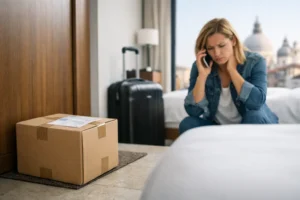
A delivery attempt at an empty holiday property can create far more work than the parcel itself. You may be asked to rearrange delivery from another country, collect it from a depot with limited opening hours, or discover that an important item has been returned to sender. To avoid missed parcel deliveries, you need more than a tracking number. You need a delivery arrangement that still works when you are travelling, living seasonally or managing a business remotely.
For residents, non-resident owners and businesses in Gran Canaria, the challenge is often consistency. A flat may be unoccupied for months, a development may have restricted access, or a courier may not be able to leave a parcel safely. The right process keeps you informed and gives every delivery a clear destination.
Why parcels are missed in the first place
Most failed deliveries are not caused by a single major error. They happen because small gaps in the delivery journey add up. An incomplete address, an unmarked entrance, a courier arriving while you are out, or an unavailable recipient can all lead to the same outcome: a missed attempt.
Properties used only part of the year are particularly vulnerable. Couriers cannot assume a neighbour is available, and leaving a parcel outside is rarely a sensible option. In shared buildings, entry systems, concierge arrangements and communal post areas can also make a delivery more complicated than the sender expects.
Business deliveries have their own risks. Stock samples, signed documents, replacement equipment and client materials may arrive outside office hours or while a team is working from another location. If the address is not staffed reliably, a missed parcel can become a delay to operations rather than a minor inconvenience.
Start with a complete, delivery-ready address
A clear address prevents many avoidable problems. Use the recipient’s full name or business name exactly as it appears on the door, directory or authorised receiving arrangement. Include the building name, flat or unit number, street, postcode and locality. If a development has a gate, make sure any relevant access information is provided through the courier’s delivery preferences where possible.
Avoid relying on vague directions in the address field. Phrases such as “near the pool” or “second house after the supermarket” may be useful to a visitor, but they are not a dependable substitute for a proper postal address. They can also be lost when a retailer passes your details from its checkout system to a courier.
Check the address before placing every order, especially if you have several homes, a former business address or a temporary stay in Spain. Online shops often save previous addresses by default. A single click can send an item to a place where nobody is available to receive it.
Choose a receiving point that is available when you are not
The most effective way to avoid missed parcel deliveries is to use an address with a reliable recipient in place. Depending on your circumstances, this may be a staffed workplace, a trusted local contact, a collection point, or a professional parcel reception service.
For people who travel frequently or do not live permanently in Gran Canaria, a virtual mailbox and parcel reception service can provide a more stable option than asking neighbours for repeated favours. Parcels are received at a secure physical address, held safely and managed according to your instructions. This gives you control without requiring you to be at the property on the day a courier calls.
The arrangement needs to suit the type of items you receive. Before choosing a service, confirm which carriers it accepts, whether it can receive signed-for deliveries, the maximum parcel sizes and weights, storage periods, collection arrangements and forwarding options. Some providers may have restrictions on valuable goods, temperature-sensitive items or items requiring identity checks.
Letterbox.es is designed for this kind of practical continuity, combining a dependable address with mail handling, parcel reception and forwarding options for customers who need to stay reachable from abroad.
Use tracking as a decision tool, not just a notification
Tracking is most useful before the courier reaches your door. Once you receive a dispatch notice, check the estimated delivery date and whether the carrier offers delivery preferences. You may be able to nominate a safe receiving point, select an alternative day, arrange collection or add instructions through the courier’s own system.
Do not wait for a “missed delivery” message to act. If you know you will be travelling, redirect the parcel before the delivery window where the retailer and courier allow it. This is especially valuable for time-sensitive items such as legal paperwork, replacement keys, work equipment or parcels required for a guest arrival.
Keep notifications switched on for orders that matter. Delivery alerts by email or mobile phone can help you respond quickly, but they should not be your only safeguard. Couriers sometimes change routes, bring a parcel earlier than expected or separate an order into multiple deliveries. A dependable receiving address remains useful even when the tracking information is imperfect.
Give couriers instructions they can actually use
Delivery notes should be brief, practical and safe. Useful instructions might explain which entrance to use, the name on an intercom, or where an authorised recipient is available. They should not ask a courier to leave valuable goods in an exposed communal area, outside a gate or in an unlocked bin store.
It is also worth considering privacy. Avoid including personal information that does not help complete the delivery. A courier needs access details, not a detailed explanation of your travel schedule or an announcement that the property is empty.
If a parcel requires a signature, make sure the person or service receiving it is authorised to do so. This matters for both proof of delivery and any later claim. An informal arrangement can work for occasional low-value items, but it may not be appropriate for business assets, important documents or regular deliveries.
Plan for forwarding, storage and collection
Receiving the parcel is only the first part of the process. Decide in advance what should happen next if you are not nearby. You may want items stored until your next visit, forwarded to your current address, or made ready for collection by someone you trust.
Each option has a trade-off. Storage is convenient if you return soon, but it may not suit urgent purchases or limited space. Forwarding gives you access wherever you are, although it adds delivery time and cost. Collection is often the quickest choice when a local colleague, property manager or family member is available, but only if the handover can be arranged securely.
For business users, create a simple internal rule for incoming parcels. Identify who receives notifications, who approves forwarding costs and who is permitted to collect items. This avoids confusion when a package arrives for a director, a remote employee or a trading name rather than the person managing the address.
Be realistic about forwarding times
Forwarding is useful, but it is not instant. If you need an original document by a fixed date, allow time for processing and international transit. Scanning is often the quicker answer for routine letters, while physical forwarding makes more sense for cards, certificates and anything you must keep in its original form. See how a Spain mail forwarding service works for the details.
It also helps to separate where you live from where you receive post. Your home may change; your delivery address should not. For a business, a dedicated address keeps company correspondence apart from personal deliveries and makes admin easier when more than one person needs to see what has arrived.
Keep records for important deliveries
Save order confirmations, tracking references and proof of delivery for higher-value or business-critical parcels. If an item goes missing, these details make it easier to speak to the retailer, carrier or receiving service promptly.
Photographs of damaged packaging and a record of the date it was received can also be useful. The key is to report an issue quickly and follow the carrier’s or seller’s stated claims process. Delays can make a straightforward problem harder to resolve.
For regular shipments, review what is arriving and where it is being sent. A subscription box, office supplies order or automatic replacement delivery may still be linked to an old address long after you have changed your routine. Updating recurring orders is one of the simplest ways to reduce failed delivery attempts.
A more reliable routine for every delivery
There is no single solution for everyone. If you are usually at home, accurate address details and active tracking may be enough. If you split time between countries, own an unoccupied property or operate without a permanent office, a secure receiving arrangement offers much greater certainty.
The goal is not simply to make parcels arrive. It is to make sure they are received safely, recorded clearly and available to you on your terms. With a stable address and a plan for what happens after delivery, you can travel, work and manage your property without organising your day around the doorbell.