
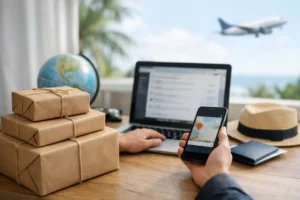
You do not usually think about parcel handling until something goes wrong. A missed delivery at your property in Spain, a signed-for letter no one can find, or a time-sensitive document sitting in a communal hallway can quickly turn a minor issue into an expensive one. If you need to manage parcels while overseas, the real priority is not convenience alone. It is control.
That matters whether you are a seasonal resident, a non-resident property owner, an expat splitting time between countries, or a business owner running operations remotely. Parcels and post do not stop because you are abroad. Tax letters, replacement bank cards, legal notices, customer returns, supplier deliveries and personal purchases still need a reliable destination and a clear process behind them.
Why it is hard to manage parcels while overseas
Most delivery systems assume someone is physically present. That is the basic problem. If your address is a holiday property, a rented flat, a shared building or an office you do not use daily, deliveries become unpredictable very quickly.
Carriers may leave parcels with neighbours, in building entrances or with reception staff who change regularly. Some couriers do not give useful tracking updates, and others expect a local mobile number or quick response within working hours. If you are in a different country, a different time zone, or simply in transit, those small frictions build up.
There is also a difference between consumer inconvenience and administrative risk. Missing an online order is annoying. Missing official post is something else. Documents linked to banking, residency, business registration or property management often have deadlines attached. When you are not there to receive them, your system needs to be dependable rather than improvised.
The best way to manage parcels while overseas
The most reliable setup is simple. Use a secure address for receipt, put clear handling rules in place, and make sure you can review incoming items remotely before deciding what happens next.
For most people, that means moving away from ad hoc solutions such as asking a neighbour for favours or hoping a property manager will keep an eye out. Those arrangements can work for occasional deliveries, but they are not designed for continuity. They depend too much on other people’s availability, memory and priorities.
A better arrangement gives you three things. First, a stable physical address where post and parcels can be accepted consistently. Second, visibility, so you know what has arrived without being on site. Third, options, so items can be stored, scanned or forwarded based on urgency.
That combination is what turns parcel handling from a recurring problem into a manageable process.
What a remote parcel system should include
A good setup starts with secure receipt. If a parcel arrives, it should be accepted at a recognised address by someone who is expecting it and knows how to log it properly. That sounds basic, but it removes the biggest source of delivery failure.
After receipt, visibility matters. For letters and smaller documents, digital scanning is often the fastest way to stay informed. You do not always need the physical item immediately. In many cases, seeing the contents quickly is enough to decide whether it can wait, needs forwarding, or should trigger an action on your side.
For parcels, storage is just as important as delivery acceptance. You may not want every package forwarded at once, especially if you are between locations or trying to avoid repeated shipping costs. Secure storage gives you breathing space and lets you consolidate shipments when it makes sense.
Forwarding should be handled as a controlled service, not a last-minute favour. That includes using the correct destination address, suitable timing, and a method that reflects the value or urgency of the contents. A low-value retail order and a critical signed document should not be treated in the same way.
Choosing between scanning, storage and forwarding
The right choice depends on what is arriving and how quickly you need it.
If the item is a document and the information matters more than the paper itself, scanning is often the most efficient option. You can review it quickly, share it if necessary, and decide later whether the original needs to be retained or sent on.
If the item is physical, valuable or difficult to replace, secure storage may be the safer first step. This is particularly useful for travellers moving between addresses, or for property owners who only visit every few months. Storage keeps the item protected while you decide what to do next.
Forwarding is best when the parcel is genuinely needed at your current location, or when holding it creates more risk than moving it. The trade-off is cost and timing. International forwarding can be entirely worthwhile, but only when used selectively. Sending everything automatically is convenient in theory and expensive in practice.
Common mistakes people make overseas
One of the most common mistakes is using an address that is technically valid but operationally unreliable. A holiday property, short-let flat or shared building can receive post, but that does not mean items will be handled properly after delivery. There is a difference between a place couriers can find and a place that can manage incoming items consistently.
Another mistake is relying on a single person informally. A helpful neighbour or caretaker can be useful in a pinch, but they are not a system. They go away, get busy, forget to message, or simply do not want the responsibility of dealing with repeated deliveries.
People also underestimate the value of speed at the information stage. They think the issue is where the parcel goes, when often the bigger issue is how quickly they know it has arrived. Fast visibility changes decision-making. It gives you time to respond before a routine delivery becomes a problem.
Then there is the business side. Entrepreneurs and small companies often mix personal and trading deliveries through whichever address is available. That works until it affects professionalism, compliance or customer confidence. If you run a business remotely, your delivery setup should support your operations, not sit awkwardly at the edge of them.
A smarter option for residents, expats and businesses
If you receive post or parcels in Spain while spending time abroad, a virtual mailbox and parcel handling service can solve several issues at once. It provides a fixed address, secure acceptance, remote visibility and controlled forwarding without requiring you to be physically present.
For seasonal residents and non-resident owners, the benefit is continuity. Your property does not need to be occupied for deliveries to be handled properly. For expats and remote professionals, the benefit is administrative simplicity. Important post is not left to chance, and you are not constantly redirecting deliveries between temporary locations.
For businesses, the benefit goes further. A professional mailing address supports a more credible presence, while parcel reception and document handling help keep day-to-day operations moving. If you also need occasional office access or a base for meetings, the setup becomes more than a post solution. It becomes part of your operating infrastructure.
This is where a provider such as Letterbox.es fits naturally. The value is not only that someone receives your items. It is that you stay informed, organised and reachable without building your schedule around deliveries.
How to set up a system that actually works
Start by looking at what you receive most often. If it is mainly documents, prioritise scanning and notification. If you receive regular parcels, focus on secure receipt and storage. If you run a business, consider whether your address also needs to support registrations, customer communication or a more professional image.
Next, separate urgent items from routine ones. Not everything needs immediate forwarding. In fact, many people overspend because they treat every delivery as urgent when only a small proportion genuinely is.
Then make sure the address you use is one you can keep long term. Stability matters. Repeatedly changing delivery details across banks, suppliers, official bodies and online retailers creates unnecessary friction and increases the chance of mistakes.
Finally, choose a service with a clear process. You should know how items are received, how you are notified, how long storage is available, and what forwarding options exist. Practical clarity matters more than flashy features.
Managing parcels from abroad is not really about parcels. It is about keeping your personal life, property or business moving without interruption when you are not on site. Once you have a secure address and a dependable process behind it, distance stops being the problem it used to be.