
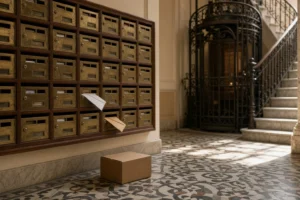
Barcelona draws people who are not there every day of the year: remote workers on a long stay, owners of a flat they visit a few times a season, students between terms, and businesses with clients in Catalonia but staff elsewhere. All of them run into the same small, stubborn problem sooner or later. Post and parcels keep arriving, and someone needs to be there to receive them.
This guide explains how post works in Barcelona, the local quirks that cause missed deliveries, what your options are when you are not around, and how a dedicated mail address in the city fits in.
Who Needs a Mail Address in Barcelona?
A reliable address in the city is useful for anyone whose post should not depend on where they happen to be sleeping. Typical cases include:
- People in short or rolling rentals, where the landlord, the letterbox or even the flat may change before an important letter arrives.
- Second-home owners who spend part of the year in Barcelona and do not want bank, utility or community letters piling up in a shared hallway.
- Digital nomads and long-stay visitors who order things online and need somewhere secure for deliveries.
- Remote businesses and freelancers who want a Barcelona contact address for customers and suppliers without renting an office.
- People who have moved away but still receive the occasional letter from a Spanish bank, insurer or public body.
How Barcelona Addresses Are Written
A surprising number of missed deliveries in Barcelona come down to an incomplete address. The city has 42 postcodes for its own addresses, running from 08001 to 08042, and they do not line up neatly with neighbourhoods. According to an analysis of the city council’s official address data, 37 of those 42 codes are shared between two or more neighbourhoods, so it is worth checking the exact code for a street and number with the Correos postcode finder rather than guessing from the area name.
The floor is the other common trap. The city council’s Barcelona International Welcome guide explains that the ground floor is marked 0 or PB, and ground-floor flats are called baixos (bxs.). Many older buildings, especially in the Eixample, also have an entresòl (entl.), a mezzanine above the ground floor, and a principal (pral.) above that, before the numbered floors begin. The top floors are often àtic and sobreàtic. So a “first floor” flat can be three storeys up, and a courier who reads “1” when the letterbox says “pral.” may simply give up.
Street names add a third layer. You will see both Catalan and Spanish forms, such as carrer and calle, or plaça and plaza, and a door is written after the floor, as in 2n 1a (second floor, door one). The Diputació de Barcelona style guide on addresses lists the usual Catalan abbreviations. For the general Spanish format, our guide on how to write a Spanish address correctly walks through each line.
What Happens to Your Post When You Are Not There
In most Barcelona blocks, ordinary letters go into a bank of letterboxes in the entrance hall. That works well while you are around to empty yours. When you are away, it becomes a pile that anyone with access to the hall can see, and a full letterbox is a clear sign that a flat is empty.
Anything that needs a signature is a different story. If Correos cannot hand over a registered letter or parcel, it leaves an arrival notice (aviso de llegada) and holds the item at a post office for collection, for a limited time, before returning it. The Correos collection page explains what you need to bring. If you are in another country when the notice lands, the item will usually go back to the sender before you can do anything about it. That matters most for official letters, which we cover in detail in what happens to registered letters in Spain when you are away.
The city’s main post office, the Oficina Principal de Correus in Ciutat Vella, is open on weekdays according to the council’s directory, but your notice will normally send you to whichever office serves your postcode, and that can be anywhere in the city.
Your Options in Barcelona
There is no single right answer, and each option suits a different situation.
- A friend, neighbour or building porter. Free and simple if you have someone reliable, but it depends on their goodwill and their diary, and they cannot collect signed-for items without your authorisation. Our guide on whether someone else can receive your post for you covers how that works.
- Citypaq lockers and pick-up points. Correos runs Citypaq parcel lockers across the city. They are handy for online orders while you are in Barcelona, but collection windows are short, so they do not help if you are away for weeks.
- Your accommodation. Hotels and some rentals will accept a parcel if you ask first, though policies vary and nothing is kept once you check out.
- A staffed mail and parcel address. Your post goes to one secure address in the city, someone receives and signs for it, and you decide what happens next: read a scan, store it, collect it or have it forwarded.
A Mail Address Is Not Your Padrón Address
One point causes a lot of confusion. If you actually live in Barcelona, registering on the municipal register of residents, the padró (padrón in Spanish), is compulsory. The council’s Barcelona International Welcome pages (in Spanish) explain that you register at the home where you live, and that the registration gives access to things like public healthcare and school places.
A mail address does not replace that. It is where your letters and parcels go, not proof of where you live. If you are resident, register at your home, and use a mail address for receiving and managing post when you are away or moving about. If you are not resident, a mail address can still be a sensible contact address for banks, suppliers and online shops, but check with the organisation concerned whether it accepts a correspondence address that differs from your home address. For anything tax-related or legal, the official source or a qualified adviser should have the final word.
Choosing a Mail Address Service in Barcelona
If you go down the service route, a few questions sort the useful from the risky:
- Is the address staffed? Someone needs to be there to sign for registered letters and parcels, otherwise you are back to arrival notices.
- Do they tell you when something arrives? A quick notification, ideally with a photo of the envelope, lets you decide what to do without guessing.
- Can they scan letters? Reading a letter the day it arrives is often what stops a deadline slipping past.
- How do they store parcels, and for how long? Ask before you order something large.
- What does forwarding cost? Forwarding is normally charged on top of the monthly plan, so check how it is priced.
- Who can see your post? Your mail should be handled by a small, identifiable team, not left on a shared counter.
How Letterbox.es Can Help in Barcelona
Letterbox.es now has a location in Barcelona, alongside Gran Canaria, Cambrils and Vigo, with the same service at each. You get a secure, staffed address in the city for your post and parcels. We receive and sign for deliveries, let you know through our web app when something arrives, open and scan letters if you want to read them online, keep parcels safe and forward them to you when you are ready.
Plans are the same as at our other locations. The homepage currently shows plans from €10 a month for Receive Only, €15 a month for Receive & Scan and €25 a month for Receive & Forward, with additional charges for scanning and forwarding as listed there. You can compare the plans on our homepage and pick the one that suits you.
For everything specific to our Barcelona service, see our mail receiving in Barcelona page.
This guide is general information. Correos services, council procedures and collection times can change, so check the official pages linked above before you rely on them.