
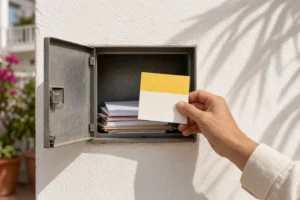
You come back to Gran Canaria after a few weeks away and find a small slip from Correos in your letterbox. Someone tried to deliver a registered letter, nobody was in, and the slip says it is waiting at a post office. The question is whether it is still there, who sent it and whether it matters that you missed it.
Registered post in Spain is how banks, landlords, lawyers, insurers and public bodies send things they need proof of. Missing one is rarely a disaster, but it can be awkward, and in some cases a deadline keeps running whether you collect the letter or not. This guide explains what happens to a registered letter when you are away, how long it waits, and what you can set up so it does not catch you out.
What the Correos Slip Actually Tells You
When Correos cannot deliver something that needs a signature, the postman leaves an aviso de llegada (arrival notice). Correos explains on its aviso de llegada help page (in Spanish) what the slip contains:
- The tracking number, where the item came from, who sent it and the date delivery was attempted.
- Whether Correos will try again or whether you need to collect it.
- The type of service, and how long the item will be held at the office. After that period it goes back to the sender.
- On the back, the address, opening hours and phone number of the office holding it.
The item is normally available from the next working day. If you were notified by SMS rather than a paper slip, Correos says you have 15 days to collect, starting the day after the message, and it sends reminders as the deadline gets closer.
The holding period printed on the slip is the one that counts. Ordinary registered letters, parcels and official notifications do not all have the same window, so read the slip rather than assuming.
Ordinary Registered Letters and Official Notifications Are Not the Same
A registered letter (carta certificada) from a company is one thing. A formal notification from a public body, such as the tax agency, the town hall, Tráfico or the social security office, is another, and the rules behind it are stricter.
Spain’s administrative procedure law, Ley 39/2015, sets out how paper notifications must be delivered. Under article 42, if nobody is at home, anyone over 14 who is at the address can accept it and give their details. If no one does, a second attempt has to be made within the next three days at a different time of day: if the first try was before 3pm, the second must be after 3pm, and the other way round.
If both attempts fail, article 44 says the notification is published as an announcement in the Boletín Oficial del Estado (BOE), Spain’s official gazette. From that point the process can carry on without you having read the letter. That is the main reason a missed official notification matters more than a missed letter from your bank.
Court papers follow their own procedural rules, which are separate again. If a slip suggests something from a court (a juzgado), treat it as urgent and get proper legal advice.
The Deadline to Respond Is Separate From the Collection Window
It is easy to mix up two different time limits. The holding period on the slip only tells you how long the post office keeps the item. The time you have to reply, pay, appeal or provide documents is written inside the notification itself.
Under article 30 of Ley 39/2015, time limits expressed in days are working days unless stated otherwise, and they count from the day after the notification takes effect. So a letter you collect late can leave you with less time than you expected, and one you never collect may still have consequences. If in doubt, contact the sender or a gestor (a Spanish administrative agent) as soon as you know something is waiting.
Electronic Notifications and the DEHú
A growing share of official post never arrives on paper at all. Article 41 of Ley 39/2015 says notifications should preferably be electronic, and article 14 requires some people to deal with the administration electronically. That group includes companies and other legal entities, plus some professionals. Private individuals can usually choose paper or electronic, and change their choice later.
Electronic notifications are collected in one place, the Dirección Electrónica Habilitada única (DEHú). According to the Agencia Tributaria’s DEHú help page, you do not need to register a mailbox first. You sign in with Cl@ve, a digital certificate, an electronic DNI or, for some other EU countries, an eIDAS login, and you see any pending notifications from the bodies that use the system.
The catch is timing. Article 43 says that where electronic notification is compulsory or you chose it, a notification you do not open within ten calendar days of it being made available counts as rejected, and the procedure moves on. If you run a Spanish company, or you opted in to electronic notifications, checking the DEHú should be part of your routine, especially while travelling. The government’s notifications page on administracion.gob.es explains the choice between paper and electronic in plain terms.
Can Someone Collect a Registered Letter for You?
Yes, in most cases. The back of the Correos slip has a section for authorising another person. Correos says that person needs the slip, their own ID and a photocopy of yours. The exception is items sent with a “deliver to addressee only” option, which only you can collect.
That works well if you have a trusted neighbour or friend nearby who will check your letterbox, spot a slip and go to the right office before the deadline. It works less well if the slip sits unseen in your letterbox for a month. We cover the wider question in Can Someone Receive My Post for Me? If you are not living in Spain at all yet, see how to receive mail in Spain without living there.
A Simple Plan Before You Travel
If you spend part of the year away from Gran Canaria, a little preparation removes most of the risk:
- Know who might write to you. Think about your landlord, bank, insurer, town hall, the tax agency and any ongoing paperwork such as a residency or vehicle matter. These are the senders most likely to use registered post.
- Get a digital ID. Cl@ve or a digital certificate lets you check the DEHú and most official websites from anywhere. Set it up before you leave, because some steps are easier in person.
- Decide where paper post should go. An empty flat is the weak point. Use an address where someone is present during working hours and can tell you when something arrives.
- Keep your details up to date. Make sure banks and public bodies have the postal address and email you actually check, so notices reach you rather than a former home.
- Arrange a backup collector. If a slip does arrive at your home, have someone you trust who can collect it with your authorisation.
For more on handling important documents from a distance, see How to Handle Legal Letters Remotely and How to Receive Legal Documents Overseas Safely. If you are deciding what address to use in the first place, our guides to a postal address for non-residents in Spain and PO box vs virtual mailbox in Spain may help.
Where Letterbox.es Fits In
Registered letters usually go wrong for one reason: nobody is at the address when the postman calls, and nobody notices the slip in time. Letterbox.es gives you a secure address in Playa del Inglés, staffed during opening hours, where your post and parcels are received and kept safe. We can scan letters so you see them wherever you are, then store or forward the originals.
If you are planning time away and want to know how we handle registered and signed-for items, get in touch with Letterbox.es and we will talk you through it.
This article is general information, not legal advice. For anything involving a specific deadline, fine or court matter, check the notification itself and speak to a qualified professional.