
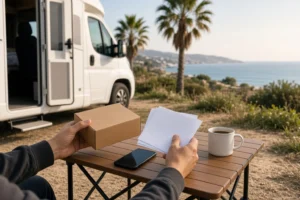
Touring Spain in a motorhome or campervan is one of the best ways to spend a winter, but it does raise an awkward question: where does your post go? Bank cards, renewal letters, spare parts and online orders all need an address, and a different aire or campsite every few days is not much use to a courier.
There is no single perfect answer. Most people who travel for months at a time end up combining two or three options. This guide walks through the realistic choices in Spain, what each one is good and bad at, and how to set things up before you leave so nothing important goes astray.
Start With What Actually Needs to Reach You
Before choosing a method, sort your post into three rough groups. It makes every later decision easier.
- Things you only need to know about. Statements, renewal reminders, letters from your bank or insurer. Seeing the contents is usually enough.
- Things you need in your hand. Replacement bank cards, a new driving licence, original documents, anything you have to sign and send back.
- Parcels. Online orders, parts for the van, medication, gifts from family.
The first group is the easiest. Switch to paperless wherever you can before you set off, and the volume of post you have to worry about drops sharply. The second and third groups are where planning matters, because they need a physical place to land and a way to get to you. For the wider options, see how to receive mail in Spain without living there.
Option 1: Have Parcels Sent to a Correos Citypaq Locker
Correos, the Spanish postal service, runs a network of parcel lockers called Citypaq. They are found in shopping centres, supermarkets, petrol stations and post offices, which makes them handy when you are on the move. Many online shops offer Citypaq as a delivery option at checkout.
When your parcel arrives you get a PIN by SMS, email or app notification, type it into the locker and it opens. No ID check and no opening hours to worry about. The catch is the time limit. Correos says on its guide to choosing between an office and Citypaq that you have five calendar days to collect. Under the Citypaq terms, if you miss that window the parcel moves to the nearest reference post office, where it waits for 15 calendar days before being returned to the sender.
Lockers work well when you know you will be in the same area for a few days. They are not the place for anything that needs a payment or paperwork on delivery, such as cash on delivery or customs charges, which the Citypaq terms exclude.
Option 2: Collect From a Post Office
Many parcel services let you choose a post office as the delivery point. Correos explains on its receiving page that you get an SMS when the item is on its way to the office you chose, a second one when it arrives, and reminders when there are 10 and 5 days left to collect it. If you would rather have a box of your own, our PO box vs virtual mailbox guide explains how Correos boxes work.
To pick it up you need a valid original ID. Correos lists the accepted documents on its collection help page, including a passport, a physical driving licence or a residence card. A photo of your passport on your phone will not do, so keep the real thing handy rather than locked in the van’s safe three campsites back.
Correos has also long offered Lista de Correos, a poste restante service where post addressed to a named office is held for collection. It can still be useful in a pinch, but procedures vary by office and many senders and online shops will not use it. Ask at the office before relying on it, and never use it for anything time-sensitive.
Option 3: Use Your Campsite’s Address
If you are staying a few weeks somewhere, the campsite may accept post and parcels for guests. Some are very good at it and some would rather not. Ask at reception before you give the address to anyone, and check:
- How they want items addressed (your name, pitch number, the campsite name)
- Whether they will sign for parcels and where they keep them
- What happens to anything that arrives after you have left
This works for one-off orders during a longer stay. It is not a good home for your bank, your insurer or anything official, because you will move on and the letters will keep coming. Getting the address format right matters here too. Our guide on how to write a Spanish address correctly explains the details couriers look for.
Option 4: Keep a Fixed Address and Have Post Scanned or Forwarded
For anything that matters, most long-term travellers settle on one fixed address that never changes, with someone there to deal with what arrives. That might be a trusted family member or a mail handling service.
The idea is simple. Everything goes to one place. Letters are opened and scanned on request, so you can read them on your phone from wherever you are parked. Parcels are received and stored. When you know you will be in one spot for a while, you ask for the things you need to be sent on.
The advantages over the other options are real:
- Your bank, insurer and other senders only ever need one address
- Nothing is returned to the sender because you missed a five-day or 15-day window
- You find out about important letters within days, not months
- You decide what is worth forwarding, instead of everything chasing you around the country
The one thing to watch is where that address is. If it is in the Canary Islands, remember that parcels from mainland Spain or elsewhere in the EU go through customs formalities on the way in, which can add time and sometimes cost. Our guide to customs on online orders to the Canary Islands explains how that works. If you are touring the mainland, an address on the mainland usually makes more sense for parcels.
Do Not Forget Official Post
Registered letters and official notifications are where touring can cause real trouble. A missed letter from a bank is an inconvenience. A missed notification from a Spanish public body can carry a deadline that keeps running whether you collected it or not.
If you have a Spanish address registered with any authority, make sure someone there can tell you when a delivery slip arrives. If you have opted in to electronic notifications, or you run a Spanish company, check the DEHú, the government’s online notification inbox, regularly while you travel. Our article on what happens to registered letters in Spain when you are away covers the rules in more detail.
Tips for Ordering Online on the Road
- Use your mobile number everywhere. Lockers, offices and couriers all rely on SMS, so make sure your number works in Spain and is on every order.
- Match the name exactly. The name on the parcel should be the name on the ID you will show.
- Time it. Order when you know where you will be for the next week, not the day before you leave a town.
- Check the carrier. Not every courier delivers to Citypaq or post offices, so look at the delivery options before you pay.
- Keep tracking numbers together. A simple note on your phone saves a lot of searching through emails at a locker.
- Bring the right ID. An original passport or physical driving licence, not a photocopy or a photo.
A Simple Setup That Works for Most Tourers
If you want a starting point, this combination covers most situations:
- Go paperless for everything you can before you leave.
- Give one fixed address to your bank, insurers and anyone official, with post scanned so you can read it remotely.
- Use Citypaq lockers or post office collection for everyday online orders while you travel.
- Have anything important, such as replacement cards or documents, held at your fixed address and forwarded to you when you are staying put.
How Letterbox.es Can Help
Letterbox.es gives you a secure, staffed address for your post and parcels, with locations in Gran Canaria, Cambrils and Barcelona. We let you know when something arrives, scan letters so you can read them from the road, store parcels safely and forward them to wherever you are when you are ready.
If you are planning a season touring Spain and want one address that stays put while you do not, get in touch with our team or have a look at our virtual mailbox service.
This guide is general information. Correos services, time limits and requirements can change, so check the official Correos pages linked above before you rely on them.